INTERVIEW
The gap between having an AI agent and trusting it
Marco Sodero, Head of Business Development, Bludigit
“The gap between simply having an AI agent and trusting it”
Marco Sodero, Bludigit
Ask Marco Sodero about digital transformation and he’ll tell you the phrase is basically exhausted. What isn’t exhausted, he argues, is the thing everyone’s actually racing toward now: agents. Not the buzzword version – actual AI systems doing real work inside a large, complicated organisation.
But Sodero is careful not to overstate where things are. Having an agent and trusting an agent are two different problems. You can build something technically capable of running a workflow autonomously and still not be ready to hand it the keys – because trust isn’t a switch, it’s something you earn by watching the thing work, checking its output, and building confidence in it over time.
Sodero runs digital services at Bludigit, part of Italgas, which serves over 13 million gas customers and 6 million water customers across Italy, and he’s blunt about the prerequisite: none of this works without years of unglamorous groundwork first. Digitalisation done properly means rebuilding processes from scratch, not replacing paper checklists with tablets. Only once that foundation exists – clean, structured data flowing from every process – does an agent have anything reliable to work with, and does anyone have grounds to trust its answers.
WorkOnSite is Bludigit‘s live example of what that trust-building actually looks like in practice. The problem it addresses is ordinary and specific: traditionally, once a job is dispatched to a field crew, visibility disappears. Nobody knows if the work got done, let alone whether it was done correctly or safely – until someone drives out to check. Now, field crews submit photos, notes and checklists directly from site, and WoS AI, Bludigit’s agent, checks that data against project specifications automatically.
Is the pipe buried at the right depth? Is the crew wearing the right gear? The agent answers – and because its answers are checked against real inspections early on, the organisation has built enough confidence in it to lean on it for more.
There is also a meaningful impact on compliance rate. When Bludigit first rolls WorkOnSite out with a new client, only about 55% of checks pass. Within a short period, that climbs past 95% – the agent influences crew behaviour and field teams begin to complete jobs correctly first time.
Watching the agent’s findings hold up, again and again, is what converts organisations from saying “we have this tool” to organisations saying “we rely on this tool.”
For Sodero, that’s the real milestone: not launching an agent, but reaching the point where nobody thinks to double-check it.
Watch the interview for the full story.
Featured in this interview:
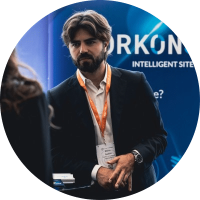
Marco Sodero
Head of Business Development
Bludigit
Chris Bernkopf is the Co-Founder and CEO of Podero, a Vienna-based energy tech startup he founded in 2022. A physicist and data scientist by training, with experience at CERN and TU Wien, he previously built Alpas (YCombinator W21), a procurement software used by companies like BASF and ABB. At Podero, he leads the company’s mission to help European utilities optimize flexible home devices – heat pumps, EVs, and batteries – and trade energy on spot markets. He is an active industry voice, contributing to publications and podcasts on energy flexibility and market reform.
About Bludigit
Bludigit delivers digital solutions purpose-built for utility operators, grounded in deep operational experience across energy and infrastructure networks. Leveraging operational know-how developed within the Italgas Group, Bludigit supports utilities in digitalizing and governing complex field operations. Its solutions enable AI-driven remote oversight of construction and maintenance activities, improving compliance, efficiency, and cost control across infrastructure projects and day-to-day operations.
Hungry for more? Check out
Future of Utilities Summit
Join senior attendees at UK's premier utilities conference.
Have a story to share?
Book a call with us to learn more.

Lewis Suckling Business Development Manager Future of Utilities
The Gap Between Simply Having an AI Agent, and Trusting It
Marco Sodero, Bludigit, in conversation
Lindley Gooden: Let’s talk about AI-driven digital transformation in field operations with Marco Sodero from Bludigit. Marco, how are you?
Marco Sodero: Hello, how are you?
Lindley Gooden: Very good indeed. Tell us a bit more about what you do.
Marco Sodero: Sure. First, for anyone who doesn’t know Bludigit – the company is part of Italgas, which is nowadays the biggest gas distribution system operator in Italy, and in Europe. We manage more than approximately 13 million customers in gas and 6 million in water. In this context, Bludigit leads and provides digital services – application infrastructure, and support for the company and other players in the market – in defining the digital journey, through our digital factory.
Lindley Gooden: Digital transformation feels like a piece of history at this point – we’ve been talking about it for a long time. How are you seeing field operations start to be automated well, and what role is AI playing in your world at the moment?
Marco Sodero: You might be surprised by my answer, because the real one is what’s called an agent. That’s the buzzword of the moment, but it’s also the real answer.
The real question is how you get there – how you adopt, govern and monitor this new kind of colleague inside a very complex organization. That’s the vision we’re working toward. But we believe that to kick it off effectively, you have to be at a very high level of digitalization first – with all the data and processing in place – so the agent has the information it needs underneath it to work effectively.
Lindley Gooden: So the foundations have to be there. You can’t go agentic without them.
Marco Sodero: Exactly. And there’s also a level of “agentic” involved – being fully autonomous takes time, because you need to build up trust in the results the agent is giving you.
Lindley Gooden: Do you feel the industry has still got a long way to go? Are we at the early stages?
Marco Sodero: What we’ve done over the last five to seven years is work on this digitalization process. Digitalizing isn’t just replacing paper with tablets, or adding some digital touches here and there – it means reviewing the processes from the ground up, understanding what’s actually needed, and redesigning them.
Out of that, you get all the data coming from your processes feeding into a data lake – structured, clean, reliable data that can feed the agent. That’s when it can run new workflows autonomously. That’s what we’re pointing toward now.
Lindley Gooden: Field operations – measurement, monitoring, everything out in the field – are notoriously difficult. You’re often working with old infrastructure, and it takes a lot of work to get right. Tell us about WorkOnSite. How does it work, and how does it help?
Marco Sodero: WorkOnSite was born exactly out of that kind of process. We sat down with our colleagues who handle construction site supervision, and we tried to understand what was actually going on. We quickly realized that site supervision is one of the most traditional processes there is – you send people out to keep an eye on what the field crew is doing.
The problem is, once activities are dispatched from the field service platform, you lose all visibility into what the crew is actually doing.
Lindley Gooden: I suppose a lot of this depends on having a foreman on site, and people who are experts in their own heads, but it’s not always the same people – it depends on who’s working which shift.
Marco Sodero: Exactly. So you don’t know whether the work is done, whether it’s done properly, or whether it’s done safely. Whether it’s investment activity or maintenance, it’s always important to know what the field crew is doing and to check on that constantly.
Lindley Gooden: And making it consistent, so it can be replicated and you land on best practice, is important too.
Marco Sodero: Exactly.
Lindley Gooden: And WoS AI is something else again – tell us how that works, because you need constant, live monitoring that filters through, not just as a standard, but as the work happens.
Marco Sodero: WorkOnSite really does three main things. The first addresses the visibility problem – it collects data from the field in a structured way, directly from the crew: pictures, notes, checklists. Once that information is collected, based on the type of activity being carried out, it gets verified through WoS AI, our agentic AI tool, which checks that everything is compliant with the project specification.
A concrete example: is the depth of a pipeline we’ve just laid compliant with spec? Is the person on site wearing the correct hat, the correct shoes, the high-visibility jacket? Is the work being done properly, and are people working safely? That’s what WoS AI checks.
But it’s not just a validator – the aim is to have something closer to a colleague that’s always working, able to answer any question you put to it. How many construction sites opened today? How many activities were completed yesterday? That kind of thing.
Lindley Gooden: And the last thing anyone on site wants is more complication – so how convenient and quick is it to actually use?
Marco Sodero: What we’ve seen is that the benefits are quite consistent across all the clients we’re onboarding onto WorkOnSite. I’d summarize them in three pillars.
The first is quality. Just the fact that the field crew knows they’re being monitored every day changes their behavior – they get better, because they know they can’t get away with mistakes. To give you a number: when we first roll WorkOnSite out with a new client, usually only about 55% of checks come back validated okay. But we see a very quick shift – that 55% moves above 95%, because the crews know they’re being watched, so they care more, and they do the work well.
Lindley Gooden: That’s a huge jump. I imagine they end up thanking you for it, even if it means realizing they weren’t doing everything they should have been.
Marco Sodero: Exactly – they thank us, because it helps them in the long run. The second pillar is about on-site visits. Without a tool like this, the data doesn’t come to you – you have to go to the data, sending people out to see what’s happening, to collect notes. Now we’re flipping that: the data comes to us, already validated, so we’re not validating it at the end of the month. The quality is already checked as it arrives.
Lindley Gooden: And the feedback you’re getting is good, I assume?
Marco Sodero: From clients, certainly – because it’s working.
Lindley Gooden: Do you know what the actual workers on site think of it?
Marco Sodero: In a nutshell, the point is that we’re increasing quality and increasing safety on site, with lower costs. That’s what clients need. We started with Italgas, but we’re now expanding into the external market, and it’s being well received there too.
Lindley Gooden: Brilliant. Thanks for joining us, Marco – it’s great to get inside how this actually works. Until you understand the process and the results, you’re always wondering whether something like this will work for you. But clearly it’s working for a lot of people already.
Marco Sodero: Thank you for having me.
Lindley Gooden: That’s it for this episode of Future of Utilities: Insights. See you next time.
Stay in the loop with Future of Utilities
Subscribe to our newsletter to receive news, insights and special offers.
By submitting this form you agree to our Privacy & Cookies Policy and Terms & Conditions